Game designers spend enormous energy solving a problem that nature solved millions of years ago: how do you create an experience hard enough to feel meaningful but rewarding enough to keep players moving forward?
The crypto gaming space has grappled with this more explicitly than traditional gaming. Early GameFi models collapsed because they front-loaded rewards and back-loaded difficulty, producing economies where players extracted value and left before the experience could deliver anything intrinsically worth staying for. The lesson from failed play-to-earn ecosystems is the same lesson any game designer eventually learns from player drop-off data: rewards that arrive before effort feel like exploits. Rewards that arrive after genuine difficulty feel earned, and earned rewards produce the retention that no tokenomics model can manufacture.
El Altar volcano in Ecuador’s Sangay National Park has been running the same difficulty-reward structure for millions of years. It does not have a development team, a whitepaper, or a token economy. What it has is one of the most precisely calibrated challenge-to-payoff ratios of any experience a human being can have. For game designers thinking about how blockchain features should be integrated into gameplay without producing the alienation that killed the first generation of Web3 titles, El Altar is a study worth taking seriously.
The World Map: Remote, Uncharted, Deliberately Inaccessible
Every compelling game world contains areas that signal difficulty through geography before a player ever enters them. Dark zones, fog of war, the region past the bridge that requires a higher level to cross. The signal is the same across games: this territory is not for everyone. Not everyone will reach it. This creates desire.
El Altar operates on the same principle. It sits 170 kilometers south of Quito inside Sangay National Park, one of the least-visited protected areas in Ecuador. The trailhead at Hacienda Releche is not on the main road. The signage is incomplete. Local guides who work the mountain describe the trailhead as difficult to locate even for people who have been given directions to it. The first friction point in El Altar’s difficulty curve is literal: finding the starting point.
This is not a design flaw. From a player experience standpoint, it is a filter. The effort required to reach the starting point of El Altar — the flight to Quito, the bus to Riobamba, the acclimatization days at altitude, the transport to a trailhead that requires local knowledge to find — selects for participants who have already committed. By the time someone steps onto the muddy Andean trail that begins the trek, they have passed a significant investment threshold. The drop-off rate on the first day is therefore low. Players who have invested this much don’t quit easily.
El Altar Ecuador Tours functions as the matchmaking system that connects players to this world — verified operators, certified guides, pre-arranged mule logistics, transport to the trailhead — removing the friction that would prevent committed players from reaching the starting point without removing the meaningful challenge that makes the experience worth reaching.
Day One: The Grind Phase and Why It Works
No game designer wants to talk about the grind, but every successful game has one. The grind is the portion of gameplay between onboarding and the first major payoff where the core loop is established, the player’s competence is tested, and the commitment to proceed is renewed through effort rather than novelty.
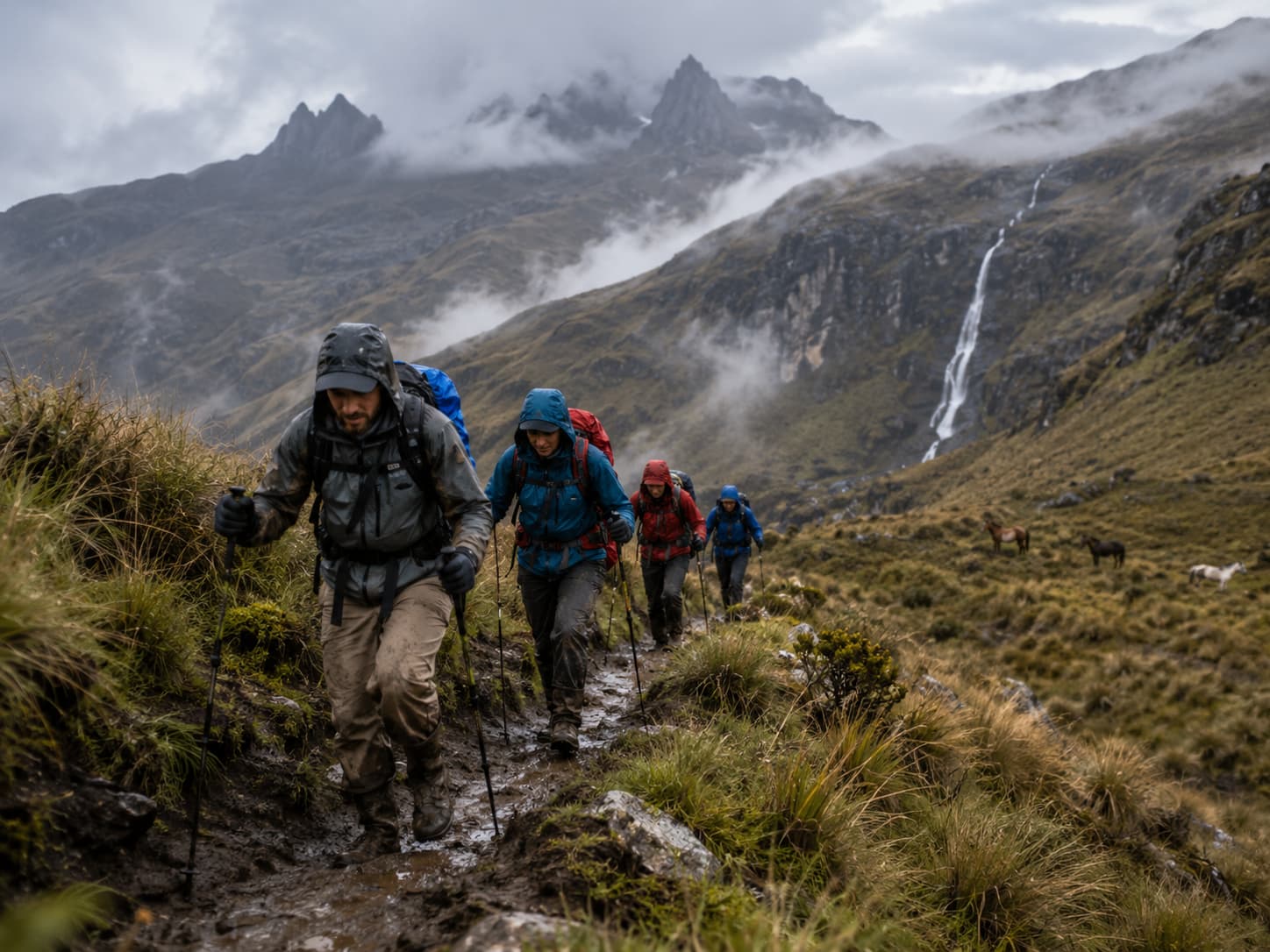
Day one of El Altar is seven to eight hours of steep, muddy climbing from 3,070 meters at the trailhead to approximately 4,000 meters at the Collanes refuge. The trail is characterized by deep Andean mud — horse-churned, ankle-grabbing, boot-consuming — that requires active concentration on every step. The altitude produces a physiological throttle: your lungs operate at reduced efficiency, your muscles require more recovery between exertion, and the pace that would be comfortable on flat terrain at sea level requires genuine effort here.
What makes this grind work, rather than produce dropout:
The feedback loop is continuous. Every hour of climbing produces visible altitude gain and visible terrain change. The green valley at the trailhead recedes. The páramo landscape — the high Andean moorland ecosystem found almost nowhere else on Earth — replaces it with a visual environment that signals progress. Wild horses appear at unexpected intervals. Waterfalls cascade down mountainsides that were invisible from below. Each environmental trigger tells the player they are deeper into the world than they were an hour ago.
This is textbook progression design. The grind never shows the player the same screen twice. The landscape is not a treadmill. It is a sequence of environmental checkpoints that provide intrinsic reward for forward motion without requiring the game to deliver a loot drop or token allocation.
Critical design note: The difficulty in early GameFi titles was not that grinding existed. It was that grinding produced only financial reward, which meant players could calculate the expected value per hour and stop playing the moment the math turned negative. El Altar’s grind produces experiential reward — the páramo, the altitude, the physical sensation of ascending a mountain — that cannot be calculated against opportunity cost in the same way.
The Checkpoint: Collanes Refuge at 4,000 Meters
Every well-designed progression system includes checkpoints — save states that allow players to rest, regroup, and prepare for the next challenge without losing all accumulated progress. The Collanes refuge sits at approximately 4,000 meters, reached at the end of Day 1, and functions as exactly this: a physical structure in a remote páramo valley where guides cook dinner, trekkers dry gear, and the mountain allows a rest before the final push.
The checkpoint serves multiple psychological functions that game designers will recognize.
Progress anchoring. At the refuge, the distance covered becomes tangible. Trekkers have gained nearly 1,000 meters of altitude and covered approximately 12 kilometers of difficult terrain. The effort is behind them, locked in. This is the function of a save point: it converts recent effort into permanent progress that cannot be lost to a future mistake.
Information delivery. The guide briefing at the refuge covers Day 2: the route across the marshy altiplano grasslands, the final wall approach to the crater rim, what to expect from the altitude at 4,200 meters. Players receive information necessary for the next challenge only after completing the prerequisite challenge. This sequencing — knowledge unlocked by progress, not granted before it — mirrors the tutorial design principle of revealing mechanics at the moment they become relevant rather than front-loading everything before the player has context to absorb it.
Community formation. Small-group treks at El Altar mean the Collanes refuge produces exactly the kind of social bonding that player retention research in gaming consistently identifies as the strongest retention mechanism available. Players who form emotional connections with other players stay in ecosystems longer than players motivated purely by financial or achievement incentives. The shared difficulty of Day 1, processed together over dinner at 4,000 meters, creates the same cohesion that guild mechanics create in MMOs.
The Final Boss: The Wall Before Laguna Amarilla
Day 2 of the El Altar trek crosses marshy altiplano grasslands from the refuge toward the crater rim, and it ends with a specific section that every person who has completed it describes in nearly identical terms: a steep, slippery wall of volcanic rock and mud that requires hands as well as feet, at 4,100 to 4,200 meters of altitude where the air is measurably thin and every step costs more than it should.
This section is the final boss.
It is not technically difficult in the mountaineering sense — no ropes or technical equipment are required. What it requires is the willingness to continue past the point where your body is sending clear signals to stop. At this altitude, breathing is labored. Your legs are carrying the accumulated fatigue of Day 1 plus several hours of Day 2. The wall is steep enough that you cannot see the top from the bottom, which means you cannot measure how much effort remains.
Game design parallel: The best boss encounters in any medium share a specific structure. They arrive after the player has been pushed through a preparation phase that seems almost too demanding. They require applying skills developed through the preceding challenges but at a higher intensity. They occur at a point where the player’s resources — health, stamina, patience — are at a low point. And they are immediately followed by the experience that makes everything retroactively worth it.
The crater lake is on the other side of the wall.
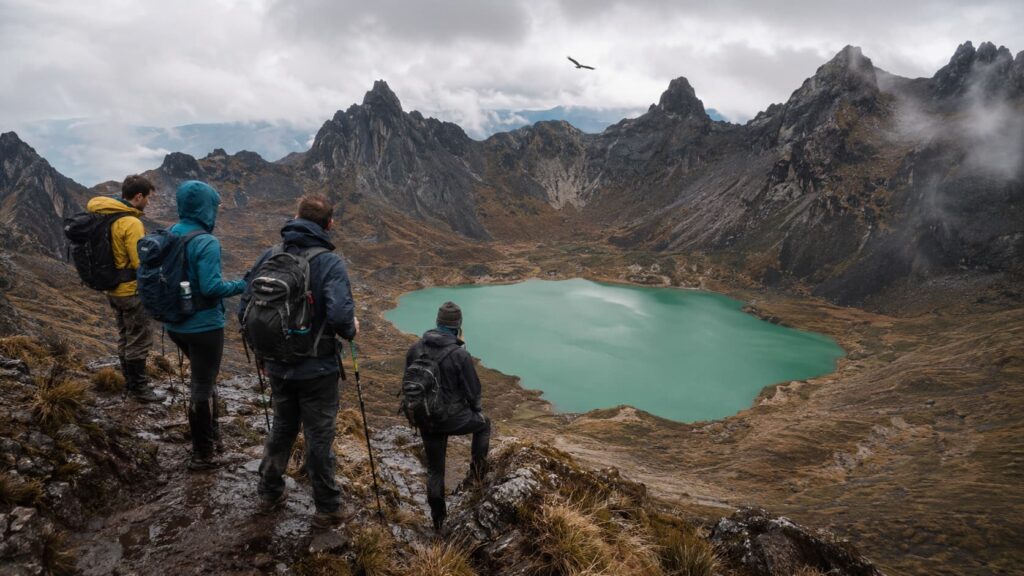
Laguna Amarilla sits at 4,200 meters inside the collapsed crater of an ancient volcano, surrounded by nine volcanic peaks arranged in a horseshoe curve. The color of the water shifts between turquoise and green depending on the light and the mineral content of the volcanic springs that feed it. Condors occasionally fly overhead at eye level or below. The nine peaks — El Obispo (The Bishop) at 5,319 meters, Monja Grande, Monja Chica, Tabernáculo, and five Fraile variants — form a natural amphitheater around the lake that has no parallel in any landscape most trekkers have previously encountered.
The guides who have led hundreds of groups to this point consistently report the same behavior: people stand and say nothing for several minutes. Not because they lack words, but because the specific combination of physical exhaustion, high altitude, and visual overload produces a state of presence that most people do not experience in their ordinary lives.
This is the reward. And because it is delivered at the precise moment of maximum investment — after two days of demanding physical effort — it has the psychological weight that any well-placed boss payoff delivers. It could not be experienced as anything like this if it were accessible by road.
The Tokenomics of Earned Experience
The GameFi space has produced extensive documentation on what happens when rewards are dissociated from effort. Early play-to-earn titles demonstrated the endpoint of the logic: when tokens can be earned faster than they are consumed, the economy inflates, token value collapses, and players who joined for financial return leave before the underlying game has a chance to prove whether it was worth playing.
El Altar demonstrates the opposite design principle. The reward — Laguna Amarilla and the full sensory experience of the El Altar crater — cannot be inflated, duplicated, or accessed by any mechanism other than the trek itself. The value of the experience is directly indexed to the effort required to reach it. There is no shortcut. There is no secondary market where you can buy someone else’s experience. The reward is non-fungible in the most literal sense.
For designers thinking about how to create sustainable value in blockchain gaming economies, this is the architecture worth studying. The most defensible rewards in any system are those whose value derives from what they required to obtain, not from their scarcity as a commodity. A trophy that proves you completed a difficult challenge retains value as long as completing the challenge remains difficult. A token that proves you held an address at a specific timestamp retains value only as long as enough other people agree to assign it value, which is a much more fragile foundation.
The five-day Unknown Andean Trail expedition available through El Altar Ecuador Tours is a useful example here. At $1,319 per person, it follows indigenous routes to the crater lake that bypass the main Collanes Valley approach, adds wilderness camping and a hacienda night, and delivers an experience that a larger number of participants and a simpler route structure cannot replicate. The value of that experience is embedded in its difficulty of access and the quality of the guidance that makes it achievable. It has 5,506 documented completions at a 5.0 rating. The experience has not depreciated in value as more people have completed it. This is a design outcome that most gaming economies fail to achieve.
Player Retention Without Token Incentives
The most telling data point in El Altar’s player retention is behavioral rather than numerical: a significant proportion of trekkers who complete the three-day Laguna Amarilla route return for the five-day expedition or the technical mountaineering routes. The peak — El Obispo at 5,319 meters — is accessible only to experienced technical climbers and requires equipment and training well beyond what the crater lake trek demands. It represents the endgame content for players who found the base game worth continuing.
This is the retention pattern that gaming designers spend enormous resources trying to engineer. A player who completes one content tier and immediately begins planning the next tier has found genuine engagement with the system. The five-day expedition and the technical ascent routes exist precisely because the three-day trek consistently produces participants who want to go deeper into the world.
The three-day 3-Day Trek to Laguna Amarilla from Riobamba at $525 per person — bookable through El Altar Ecuador Tours — is designed as exactly this: a complete experience that introduces the world at a difficulty level that rewards effort without requiring the preparation and commitment that the technical routes demand. It covers the core loop: the grind, the checkpoint, the final boss, the legendary reward. It is designed to produce players who want more.
What Game Designers Should Actually Take From This
The parallel between El Altar and well-designed game experiences is not a metaphor stretched for effect. It is a genuine structural homology: the same principles that make a difficulty curve feel fair and meaningful in a game make a physical challenge feel worth undertaking in the world.
For blockchain game designers specifically, the implications worth extracting are:
Difficulty cannot be bypassed without destroying value. The moment a player can purchase their way past a meaningful challenge, the reward for completing that challenge becomes less valuable for everyone who earned it. The El Altar crater lake is worth what it is worth because there is no alternative path to it.
Environmental feedback replaces artificial reward. The páramo landscape, the altitude effects, the visible progress of elevation gain, the wild horses, the condors — these are intrinsic feedback signals that tell the player they are moving through something real. GameFi titles that stripped the environmental reward layer and replaced it entirely with token drops produced experiences where players could see exactly what they were getting in exchange for their time, calculate the value, and leave when the math no longer worked. The intrinsic layer is not decoration. It is the foundation.
Community formed through shared difficulty is the strongest retention mechanism available. This is as true for small-group trekking parties at 4,000 meters as it is for guild mechanics in MMOs. El Altar’s small-group format — most operators cap groups at 8 to 12 people — produces social cohesion as a natural by-product of shared challenge. It costs nothing to deliver and cannot be engineered through tokenomics alone.
The grind works when it is also the content. El Altar’s Day 1 is demanding, exhausting, and muddy. It is also the páramo, the waterfalls, the altitude, the wild horses, the condors, and the view back down the valley at sunset from the Collanes refuge. The grind and the experience are not separable. GameFi grinds failed when the grind was purely instrumental — a means to a token — rather than intrinsically interesting. Designing grind that is content is the harder problem, and El Altar solves it simply by being a mountain.
Practical Information for the Crypto-Gaming Community
For readers in the GameFi and blockchain gaming space who find this framing compelling and want to experience El Altar directly: the logistics are well-documented at El Altar Ecuador Tours.
The entry-point experience is the 3-Day Trek to Laguna Amarilla from Riobamba at $525 per person — guide, mule support, all meals, refuge lodging, and round-trip transport from Riobamba included. Acclimatization in Quito (2,850 meters) for at least two to three days before the trek is not optional advice; altitude at 4,000 meters produces measurable physical effects regardless of fitness level.
The full experience of El Altar — reaching the crater lake after two days of genuine difficulty — produces what the best game experiences are designed to produce: the specific feeling of having arrived somewhere you could not have arrived without effort, and the clear understanding that this is the only way to arrive.
The Sangay National Park official designation as a UNESCO World Heritage Site (in recognition of the park’s volcanic geology, biodiversity, and the El Altar formation specifically) provides context for what makes this landscape globally significant beyond its utility as an adventure destination.
[For more on blockchain gaming, GameFi design, and the intersection of real-world experience with digital economies, explore the articles on this site.]
About the author: Written by a game design analyst and adventure travel writer with experience in high-altitude trekking across the Andes and a background in GameFi economy design principles.